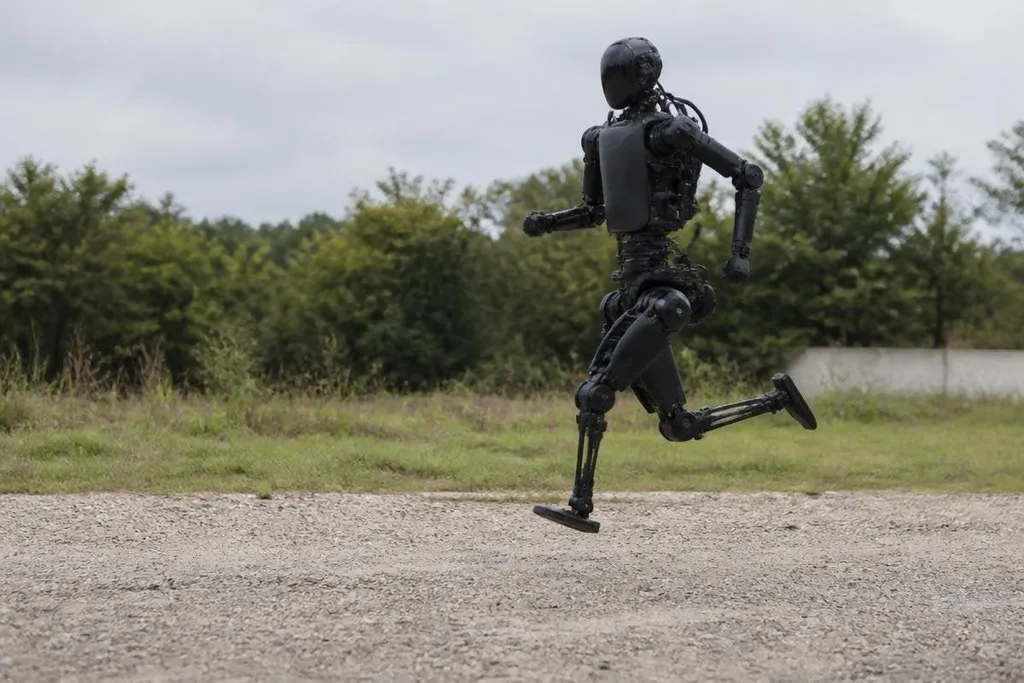
A humanoid robot can leave the ground, land on one foot, and repeat the motion. That meets a basic test for running, but it doesn’t mean the robot runs like a person. The hard part is keeping balance while the body changes speed, direction, and height.
- Running needs a brief flight phase between steps.
- A robot must place its foot before its balance moves too far.
- Human-style running needs fast control, light hardware, and safe recovery after mistakes.
What counts as running?
Walking keeps at least one foot on the ground at all times. Running includes a short point where both feet leave the ground. That flight phase gives the body more speed, but it also removes the support that keeps a walker upright.
A robot has to control its center of mass, the point where its weight acts as if it were gathered. The controller must place the next foot under that moving point, then manage the forces created when the foot hits the ground.
That impact matters. A human ankle, knee, and hip absorb part of it through flexible joints and soft tissue. A robot uses motors, gearboxes, springs, and control software. Each part adds limits, delay, or weight.
Why human running is hard to copy
Human legs store and return energy through tendons and muscles. The leg bends during landing, then extends to push the body forward. This motion reduces the work muscles must do on every step.
A robot can copy the shape of that motion with springs and powered joints, but the timing has to be right. A small error in foot placement can move the robot’s weight outside its support area. The next step then becomes a recovery move rather than part of a smooth run.
Humans also adjust without planning every joint angle. The nervous system reads pressure under the foot, body movement, and changes in the ground. A robot needs sensors for similar signals, then software that turns them into motor commands quickly enough to prevent a fall.
That control problem gets harder on slopes, loose ground, wet floors, and surfaces with different grip. A clean lab floor removes many of the mistakes that matter outside it.
Speed is only one test
A video of a humanoid robot running can prove that its feet leave the floor. It doesn’t prove that the system can run for a long period, turn safely, stop on command, or recover from a bad landing.
The useful details sit in the test method. Did the robot carry a load? Was the run controlled by a person through teleoperation? Did the video show one complete take? How often did the robot stop, reset, or fall outside the published clip?
Top speed alone says little about a humanoid that must turn, slow down, and start again. Robot24.com’s humanoid running reports can tie that speed claim to the robot, test setup, and recorded result. The useful comparison is between a straight sprint and the full movement a real site demands.
A human runner also changes speed and direction without first stopping to calculate a new plan. A humanoid robot may need a slower gait for turning, a wider step for balance, or a full stop before it changes direction. Those limits can matter more than its top speed in a factory or public space.
The hardware trade-offs
Power is one of the main limits. Running asks the motors to produce repeated bursts of force, and the battery must supply that power without making the robot too heavy. A larger battery adds mass, which then makes each step harder.
The feet matter too. Human feet deform and spread the load. A rigid robot foot can make contact easier to model, but it passes more force into the leg. A spring-loaded foot can absorb some impact, yet it adds another part that the controller must manage.
Cooling, gear wear, noise, and floor damage also belong in the test. A robot that runs for a short clip may still need a long rest before it can repeat the task. Public claims rarely answer that question without a full test report.
A practical check for running claims
Use this list when a maker says its humanoid robot can run:
- Check the flight phase: both feet should leave the ground during the recorded motion.
- Check the full clip: look for a complete start, run, stop, and recovery.
- Check the surface: note whether the floor is flat, dry, clean, and firm.
- Check the control method: separate onboard control from teleoperation.
- Check repeatability: look for several runs, not one successful pass.
- Check the purpose: decide if the robot needs speed, endurance, load carrying, or safe stops.
I'd treat a running claim as early evidence until the maker publishes repeatable tests on varied ground. Human running combines speed, balance, energy return, and recovery in one motion; a robot has to solve each part with hardware that weighs more and feels less through its feet.
The next useful benchmark is not a faster sprint. It is a humanoid robot that runs, turns, stops, and repeats the test after carrying a real load.